
Analysis of every Indiana Fever move after cap space all but runs out
The Indiana Fever were busy in free agency.
INDIANAPOLIS – The Indiana Fever gave Aliyah Boston the first ever Exceptional Performance on Initial Contract (EPIC) extension on Friday night, and that move all but eliminates their cap space for the 2026 offseason. The draft and free agency, outside of perhaps some training camp deals, appear to be done.
The Fever gave out the first EPIC extension in WNBA history (though the only players eligible for it in the entire league are Boston and Caitlin Clark, who are both on the Fever's roster), signed the first $1 million-plus contract in franchise history, and added four WNBA veterans to their roster all in about two weeks. It was a chaotic time period, and each move is worth exploring in more detail.
How did they use their cap space and what does it suggest about who could make the team? Let's explore.
 Tony East
The new Collective Bargaining Agreement (CBA) pushed the salary cup up to $7 million, and the expansion draft took two free agency options away from the Fever in Kristy Wallace and Chloe Bibby. After those two were plucked, the only players under contract for the Fever were Boston ($574,612), Clark ($528,846), and Makayla Timpson ($277,500 cap hit, which is her minimum). That left the front office with about $5.6 million to spend on free agents, draft picks, and contract extensions.
Goal number one, as Clark made clear, was keeping Kelsey Mitchell. "Our first priority is to sign Kelsey Mitchell back. [She] was first-team all-WNBA last year. Kind of my running mate in the backcourt; she makes it real easy for me. We’ve got a great squad, a great coach, a great support staff, so it’s super exciting," Clark said in late March.
There are new rules coming concerning which players are eligible for the core designation in the WNBA, per reports, but they don't kick in until 2027. Coring a player gives a team exclusive negotiating rights over an unrestricted free agent, but to get that exclusivity a core qualifying offer must be sent out: a one year deal at the supermax. Starting next year, however, only players with fewer than seven years of service will be core eligible.
Thankfully for the Fever, those rules don't kick in until next year. Mitchell has eight years of service, but the Fever could guarantee that she would stay in Indiana for another year by coring her, which made it an obvious move. She finished fifth in MVP voting last season and was named to the All-WNBA First Team.
Because Mitchell won't be core eligible next offseason, and because Clark should have an EPIC raise coming her way in 2027, a one-year deal did make good sense for both sides. Sure, the Fever would love to sign a star for longer, but locking up Mitchell for multiple seasons at the max or supermax would have given them a tight financial squeeze next year before seeing their new-look team in action. And Mitchell, even if she wants to stay with the only franchise she's ever known, can hit the open market in 2027 and get the highest contract available to her.
In the end, those factors led to the contract that made the most sense here: A one year deal at the supermax (20% of the cap, $1,400,000). That dropped the Fever's cap space to $4.2 million with eight roster spots to go (and more counting training camp deals).
All salary figures and contract lengths from Her Hoops Stats or my own reporting
Let's look at the pre-draft moves first, both because the chronology and timing are telling. This year's free agency period was unique in that it overlapped with the draft – usually it's three months before. I heard on numerous occasions that the draft timing impacted the speed of the role player market.
The best players were signed as early as possible. On April 11, for example, the Fever signed their two next-highest paid free agents in Lexie Hull and Monique Billings.
Hull was a restricted free agent and is a dynamite fit between Mitchell, Clark, and Boston as a pesky wing defender and streaky-yet-effective shooter. She's at exactly 40% from beyond the arc across the last two seasons, providing valuable spacing to go along with her ball stopping. Keeping her was a no-brainer, and it would have been difficult for Hull to leave anyway as a restricted free agent. In the end, she earned a two-year deal with a first-year cap hit of $765,000. That dropped the Fever's cap space to $3.45 million.
Billings was the team's highest-profile addition that isn't a returning player. The eight-year veteran has experience with Atlanta, Dallas, Phoenix, and Golden State. She's a taller four/five who played in a switchy system with the Valkyries last season, toggling between small five and big four. She averaged 7.3 points and 4.5 rebounds per game and could be a starter for the Fever this season while also being an option as the backup five.
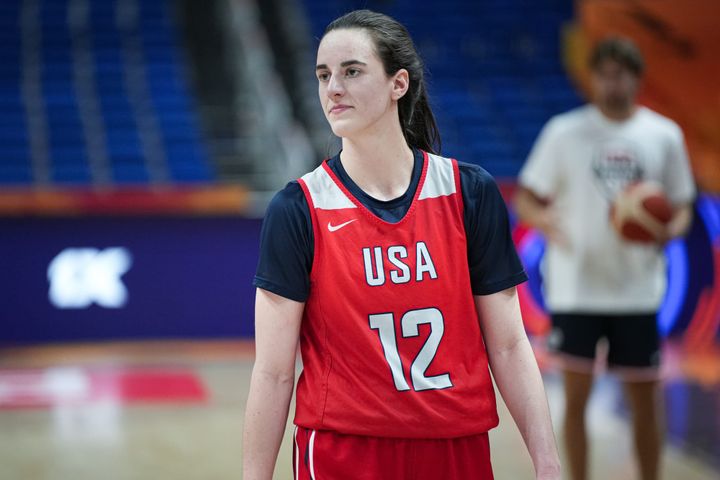
Billings also played on Team USA with Caitlin Clark in March. Despite being deployed more with reserves than starters, the Valkyries had a better offensive, yet worse defensive, rating when Billing was on the court. She took meetings with other teams before deciding to sign a two year, $1.6 million deal with Indiana. The year one cap hit is $800,000, pushing the Fever's cap space number to $2.65 million.
On April 12, the day before the draft, the Fever made three more signings. Two were returns as Sophie Cunningham and Damiris Dantas inked deals to stay with the Fever.
Cunningham is similar to Hull as a wing who can shoot. Cunningham was the better shooter and ball handler last season, but Hull was the far better defensive player and contributed a bit more within the system. They are a dynamic wing pairing, and it helps that, if needed, the Fever can go with smaller lineups that feature one of Hull or Cunningham as the four to get more shooting on the floor.
Cunningham was an unrestricted free agent and could have gone anywhere but chose to stay in Indiana on a one-year deal worth $665,000. That was the last contract over $400,000 that the Fever added, and it brought their cap space to $1.99 million.
Dantas signed the same day. She has been a hot-and-cold player in the WNBA, logging six seasons with a field goal percentage over 43% and four with that accuracy under 40%. She's never been between those posts, and three of her last four seasons have come down on the low end.
She didn't play in 2023, though, and her two seasons with the Fever have been one on (39.4% from deep and 51.2% from two) and one off (26.3% from three and 44.2% inside the arc). The former version is a valuable backup center, the latter a depth piece who shouldn't play much.
What version of Dantas the 2026 Fever get will be important. That inconsistency likely played a factor in the contract being a two-year deal at the minimum, coming with a first-year cap hit of $277,500. Just $1.71 million of space remained for the Fever.
Guard depth still needed to be addressed at this point, and the Fever's final pre-draft day signing did exactly that. Tyasha (Ty) Harris, a Noblesville native, signed with Indiana on April 12.
She's a menace on defense and has experience playing for head coach Stephanie White in Connecticut. While with the Sun, Harris was terrific in 2024 and averaged over 10 points per game for the first time in her career. That was the only season in which Harris was a primary starter.
More often, Harris has been a bench guard who can take on tough assignments while handling the ball capably when needed. That's a good fit next to Clark or Mitchell, making Harris a natural fit as a third guard for the Fever.
She was with the Dallas Wings last season and signed a one-year pact with Indiana for $400,000. $1.31 million in cap space was left over.
To that point, the Fever had a mostly complete rotation but could have used one more frontcourt piece to deploy if Timpson isn't ready for a bigger role and Dantas has another down year. Insert Myisha Hines-Allen, a bruising interior player who was named to an All-WNBA team in 2020.
That was six years ago, and Hines-Allen is no longer that level of talent. But she's still a force in the paint and as tough as they come. Despite being just six-foot-one, Hines-Allen's rebounds per minute number was even with both Boston and Natasha Howard last season. Her defensive rebounds per minute number ranked as the best of those three players.
If the Fever need a board, they can turn to Hines-Allen. She's a limited shooter but can play both frontcourt spots. Her contract came in as a one-year agreement worth $315,000. That left the Fever with $996.5k in salary cap space entering draft night, and they had two roster openings left on top of their development spots.
Draft night produced three selections, one in each round: Raven Johnson (10th overall), Justine Pissott (25th), and Jessica Timmons (40th). Johnson, who played at South Carolina, is of the Harris mold as a defensively-strong guard. Her jumper is developing and she has great intangibles. "I don’t worry about winning because Raven’s a winner," South Carolina head coach Dawn Staley said of Johnson.
Pissott comes from Vanderbilt and is a lights out shooter (42.2% on threes on over 6.5 attempts per game last season) with forward size. She's already signed a development contract, which comes with no salary cap hit. Timmons is an electric scorer who climbed over 16 points per game at Alabama last season.
As draft picks are concerned, their contracts work functionally similar to training camp contracts in that they don't count towards the salary cap until the regular season starts (outside of lottery picks, who have protected deals in year one). Johnson comes, by default, with a first-year salary of $289,133. Pissott, as mentioned, currently counts for nothing against the cap on her development deal. Timmons would count for $270,000 if she makes the team – she, too, is eligible for a development roster spot.
Because those draft picks don't count against the cap for now, mentally put them to the side. Do the same for the training camp signees. With a development deal for Pissott and a (projected, but she'll have to earn it) standard spot for Johnson, that left only one opening on the Fever's roster up for grabs.
Shatori Walker-Kimbrough is a strong candidate to get it after she signed with the Fever on April 15. She's a veteran, a former champion, and has been in a team's rotation for the last nine seasons. Two years ago, she finished third in Sixth Player of the Year voting.
Last season, her role with the Atlanta Dream was smaller. She played in 41 games and averaged just 8.6 minutes per night. That is about the maximum she projects to play for the Fever, and that is if she even makes the team or finds herself ahead of Johnson in the pecking order.
On top of Walker-Kimbrough, Megan McConnell and Kayana Traylor were added on training camp contracts. McConnell has one year of service, so her cap hit if she were to make the team would be $277,500. While Traylor has regular season experience, it came on hardship contracts that don't count toward service time. Were she to make the team, her cap charge would be $270,000.
Pissott is accounted for on her development deal. That leaves two spots for Johnson, Timmons, Walker-Kimbrough, McConnell, and Traylor on the standard roster. Those are all guards, so training camp and preseason games could decide who makes the team. Johnson should be a heavy favorite to make the final roster, and Walker-Kimbrough projects as the leader for the second spot as of now. Timmons, McConnell, and Traylor are all eligible for the Fever's final development spot.
Because each player on a training camp/draft deal will make less than $300,000 if they make the final roster, it's easy to work backwards and figure out the rest of Indiana's cap reality. Boston's EPIC extension pushed her salary to $1 million for the 2026 season, which nets a raise of $425,388. She's one of the league's best players and well worth it, and the extension comes in with three supermax years beyond the upcoming campaign.
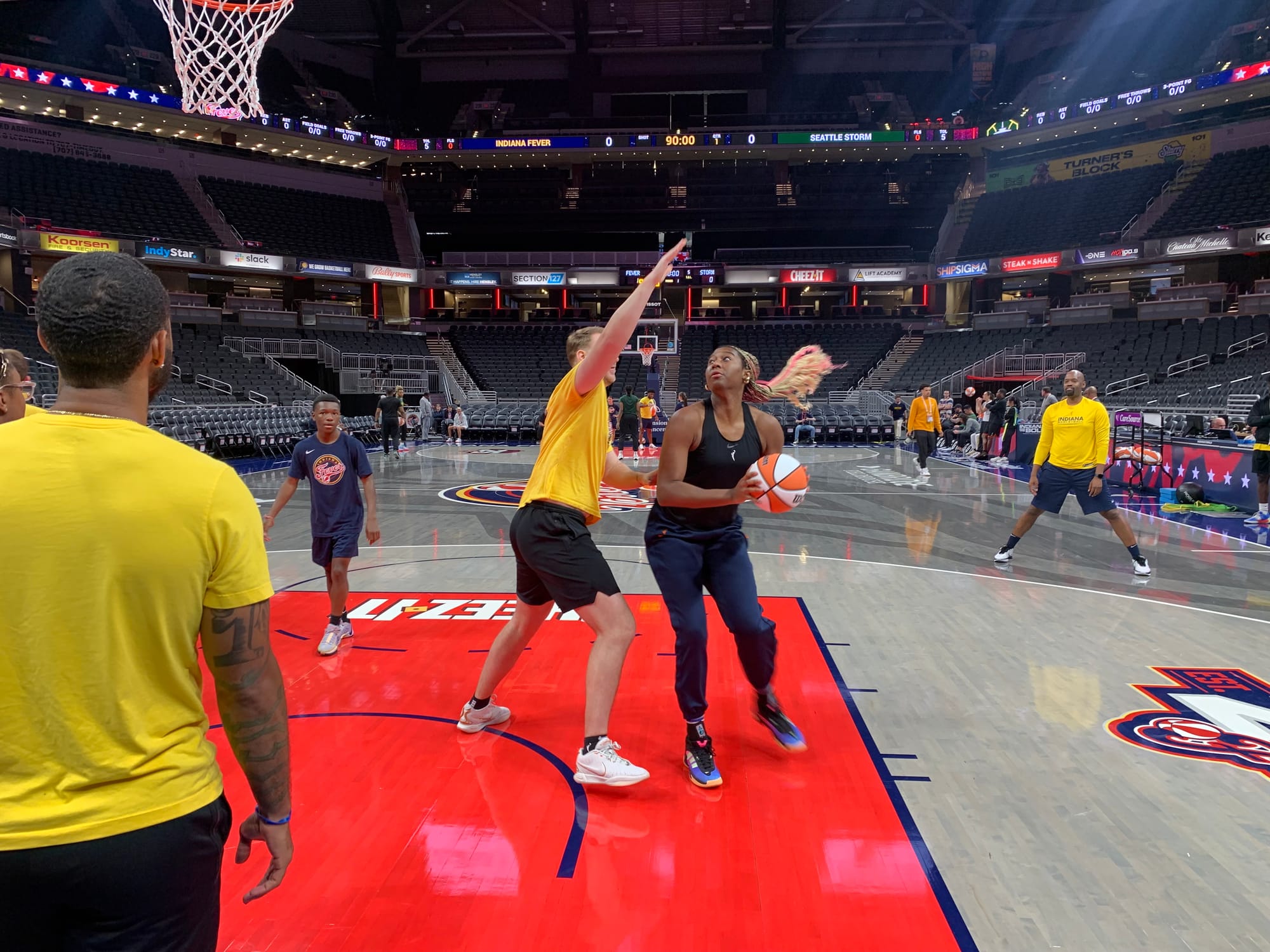
That raise chewed into the Fever's cap space and left them with $571.1k. And that amount is intentional. Of the players fighting for the final spots on the Fever's roster, the highest possible salaries belong to Johnson ($289,133) and one of Walker-Kimbrough or McConnell ($277,500). The combined sum of those two numbers? $566,633. That would leave the Fever with $4,521 in salary cap space with their complete team.
While it's possible that money is included in Boston's raise and it's a rounded reported salary number, the point stands: the Fever used every dollar they could to build their team and extend their star. With their training camp roster announced, there's nothing left for them to do.
The Fever are permitted seven protected contracts this season, which are deals that will count against the salary cap and be paid out even if a player is waived. Their protected contracts: Mitchell, Boston, Hull, Billings, Cunningham, and Hines-Allen.
Some grades —
Kelsey Mitchell (one year, $1.4 million): A
A longer deal for one of the league's best players would have been nice for the Fever. But they can still keep Mitchell in the future and will get another shot at contending with their elite backcourt, then a chance to investigate the idea of other max players instead of (or with, if players take a Liberty-esque discount) Mitchell. It would be hard to find someone better.
Lexie Hull (two years, $1.57 million): A-
Good player, good fit, and a fair price. Could the Fever have leveraged restricted free agency for a better price? Maybe, but I'm skeptical that would have been possible given that there are two new teams with money to spend, and one of them gave Shakira Austin a massive offer in free agency.
Monique Billings (two years, $1.6 million): B
Good player and a better fit, to me, than Howard was last year. Billings doesn't need the ball as often and is a better defender. While that's my opinion, the market agrees: Howard's deal with Minnesota is two years and $1.435 million.
Was it the best use of $800k in cap space? That same market says it's pretty close outside of stars taking obvious discounts. Her just-okay shooting holds back my grade even if Billings is clearly a talented player.
Sophie Cunningham (one year, $665,000): B+
I thought Cunningham was going to get a little more after free agency opened and the first few role player deals trickled in, making this seem to be good value. If her shooting holds from last season, my grade will be too low.
Cunningham was below 38% from deep in the prior two seasons, and she missed 14 games last year on top of the playoffs. She has basically nothing to prove, but her health and shooting will be worth monitoring this season. If they both hit the way the Fever hope they can, this deal will look like a steal. But it's short in length.
Ty Harris (one year, $400,000): A-
Getting Harris, a great defender and good shooter, for this amount is good business on its own. She has experience with White and is, in my opinion, a great fit.
This salary is lower than reported deals for Sug Sutton and Lindsay Allen. It's a great contract, only dinged slightly for her rim pressure limitations.
Myisha Hines-Allen (one year, $315,000): B-
I am personally enamored with Hines-Allen's game and think her force will be a fun change-of-pace element for the Fever's frontcourt. She is undersized yet plays much bigger than her height listing.
There's a chance Hines-Allen doesn't play much if the Fever prefer small groups or if others in the frontcourt become effective during the season. More options isn't a bad thing, though.
Damiris Dantas (two years, $566,100): C-
Dantas, as noted, was much better two years ago than she was last season. If 2024 Dantas is back, this will be a great minimum signing. But that's an if, and there's clear risk due to her inconsistency. The Fever may have to play Billings at backup center if Dantas' consistency, Timpson's growth, and Hines-Allen's size don't prove enough for the Fever behind Boston. And a Boston injury or foul trouble will be challenging to manage, though there are a lot of options and only a few of them need to hit.
Training camp signees (Shatori Walker-Kimbrough, Megan McConnell, and Kayana Traylor): B-
Guard depth was needed for the Fever after their constant need for players at the position last year. Clark missed much of the season and Mitchell suffered an overuse injury in the playoffs.
None of this trio projects to be in the rotation. Competition for a spot, especially at one position, seems like a smart training camp plan. A big would have been a welcome addition to this group, though.
Draft picks (Raven Johnson, Justine Pissott, Jessica Timmons): N/A
Me personally grading the picks would be rich since I don't really watch college basketball. I don't have a clue about the talent of this trio. As for the collegiate dynamic of Johnson and Clark, I thought James Boyd covered that well here.
If I had to actually grade this, I'd say a C+ since there isn't a big. The Fever hope to be good this season, so rookies shouldn't be expected to contribute much. The strengths of Johnson and Pissott do seem like good fits to me, though.
If I had any critiques for Fever free agency, it would be that there seems to be a lack of shooting in the frontcourt and not enough depth on the wing. They have enough centers, but do they have enough talent in the frontcourt? A lot depends on Dantas. They have a lot of guards, understandably. But teams can change mid-season, as the Fever showed last year, and they have talent, depth, and several positionally-versatile players. Health permitting, I think they will be a title contender again this season.
Fever fans, hello. I will be covering all sorts of Fever topics on this website along with The IX. If you sign up, every story will be emailed directly to your inbox. For now, while fans get used to something new, it's free!

Comments ()